• The Power of Peer Support in Trauma Recovery
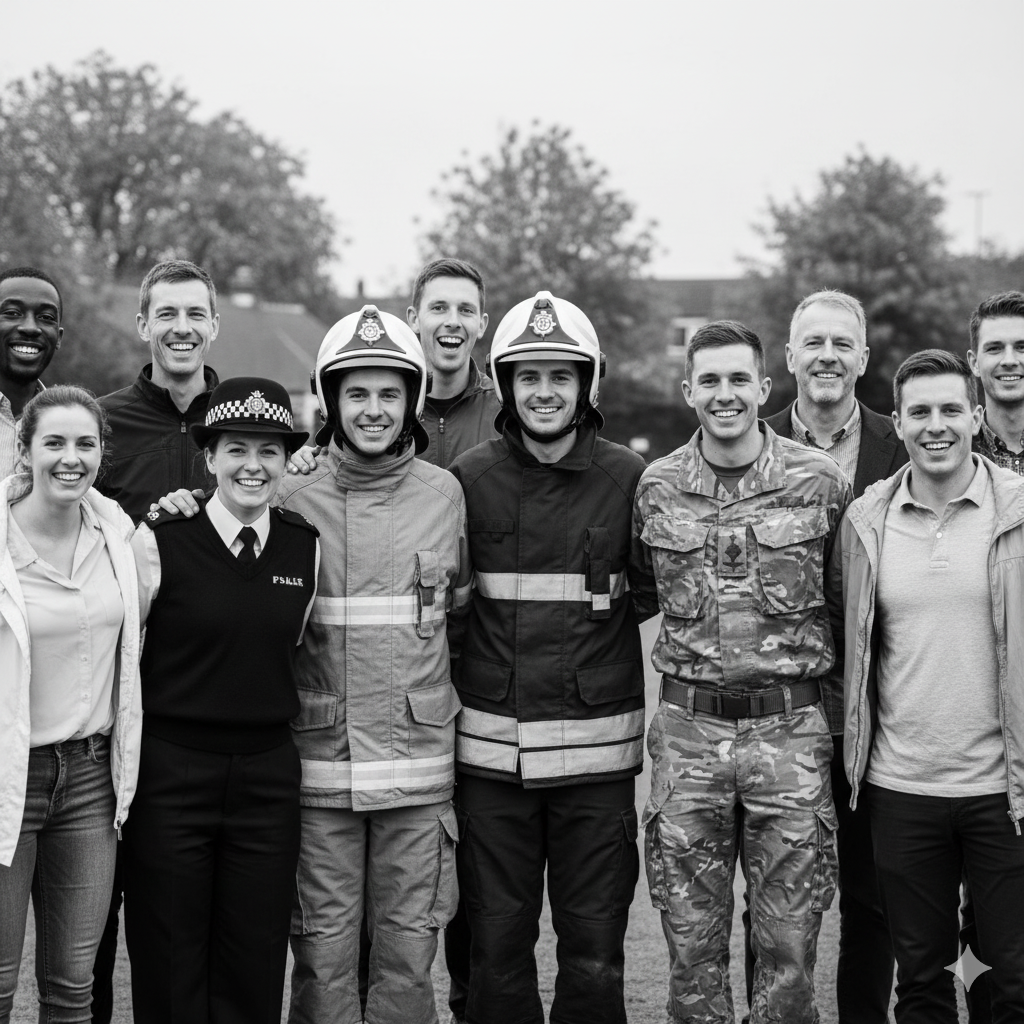
    Sometimes the most effective support after a traumatic event isn’t brought in from outside.

    It comes from the people who already understand you, your work and the environment you’ve been working in.

    That is one of the things I have always valued about Trauma Risk Management (TRiM).

    TRiM is a peer-led process designed to identify people who may be struggling following exposure to a potentially traumatic event, provide appropriate support and information, and identify those who may benefit from further specialist help. It isn’t therapy, and it isn’t about forcing people to talk about what has happened. It is about early recognition, practical support and knowing when someone needs more help.

    The approach was pioneered within the Royal Marines in the 1990s and subsequently developed and researched with King’s College London. It was later adopted across the UK Armed Forces and by organisations including the Foreign, Commonwealth & Development Office (FCDO) and police services.

    The FCDO was using trauma risk assessment and support following the devastating bombing of the British Consulate in Istanbul in 2003, where staff were killed and many others were injured or traumatised. One lost was a young woman I had started my diplomatic career with in 1996. The Foreign Affairs Committee subsequently identified many lessons from the handling of the tradegy and recorded the importance of continued aftercare for those affected.

    My own experience of TRiM came a few years later.

    In 2006, while working in Iraq, I was evacuated and went through the TRiM process myself. I was impressed by it. Not simply because someone was checking whether I was OK, but because the person doing that checking understood the environment I had come from.

    That stayed with me.

    I subsequently trained as a TRiM assessor myself, and continued using and supporting colleagues when I moved into policing.

    For me, one of the great strengths of TRiM is that it sits inside the organisation.

    There is an important place for Employee Assistance Programmes, counselling and external specialists. But when you’ve experienced something extraordinary in an organisation where the work itself can expose you to risk, there can be something particularly powerful about sitting down with someone who understands the culture, the pressures and the job.

    You don’t necessarily have to explain everything from the beginning.

    They already know something about the world you’ve just come from.

    Perhaps that is one of the most important lessons I’ve taken from TRiM: support doesn’t always have to come from outside the organisation. Sometimes resilience is strengthened by building the capacity to look after our own people from within.
    That principle has stayed with me throughout my career and is one of the reasons I created The Sanctum Program.

    Sanctum is for people like me, who regularly hold space for others – the therapists, wellbeing professionals, counsellors, managers, social workers, and “life’s givers” who are often so busy supporting everyone else that their own resilience gets pushed to the bottom of the list.

    I wanted to create something that runs much deeper than superficial self-care tips – something that understands trauma like the TRiM process does. The online Sanctum Program is accompanied by a reflective printed workbook that prompts self honesty, and is supported by insight and understanding of what you are likely to face in your role. It is for those like me who understand self investment is part of offering a better service to others.

    If that sounds like you, perhaps it’s time to create a little space for yourself.

    Explore The Sanctum Program here: The Sanctum Program
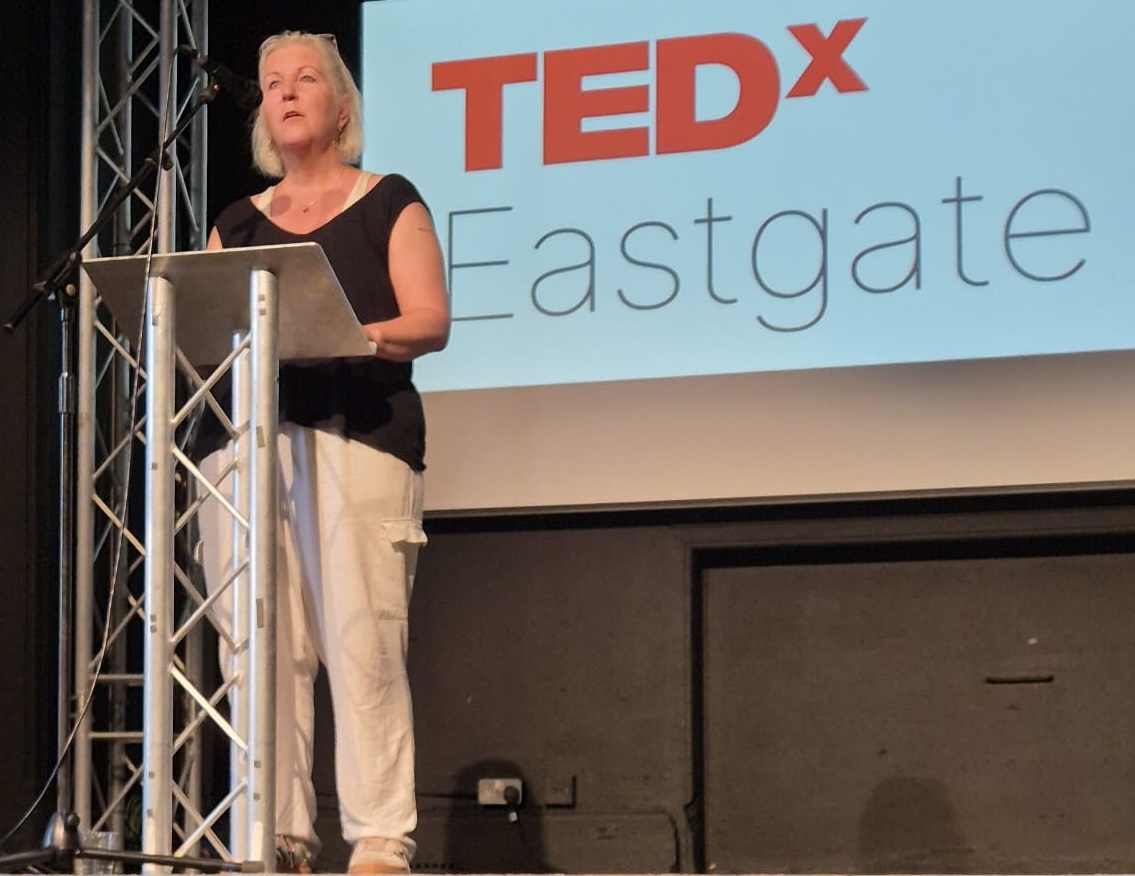
  • I’m incredibly excited – and slightly terrified – to announce that I’ll be speaking at TEDx Eastgate at Gloucester Guildhall on 20th September 2026.

    For someone whose career and life have taken me from diplomacy and war zones to policing, resilience work and some very unexpected chapters along the way, standing on a TEDx stage feels like a pretty significant milestone.

    I can’t tell you too much about the talk itself. Partly because I don’t want to spoil it, and partly because TEDx has some fairly firm rules about giving the game away beforehand.

    But I can tell you that it’s personal, it’s something I care deeply about, and it has been shaped by both my own journey and the city I now call home.

    And no – I really won’t be talking about Fred and Rose West. 😉 (well not much).

    For me, this talk represents something bigger than a speaking opportunity. It’s a chance to look back at where I started, recognise just how far I’ve come, and share something I genuinely believe is worth putting out into the world.

    I’d love you to join me and 11 other speakers at Gloucester Guildhall for an incredible evening.

    Come curious. Leave with something to think about.

    TICKETS DIRECTLY FROM GLOUCESTER GUILDHALL https://gloucesterguildhall.ticketsolve.com/ticketbooth/shows/1173678936/events/428825745

  • Over the past few years, I’ve increasingly wondered whether I have ADHD (Attention Deficit Hyperactivity Disorder).

    Having done plenty of online tests, spent time learning more about neurodiversity, and listened to the observations of a close family member with a psychology degree, I’d say there’s a strong possibility that I do.

    In many ways, the signs fit.

    The busy brain with endless ideas.
    The jumping between tasks and divergent thinking.
    The intense hyperfocus for subjects of passion and exceptional creativity
    The inability to fully rest and high energy levels
    The ability to think quickly in a crisis

    And honestly? Discovering more about neurodiversity brought a certain level of relief. There’s comfort in understanding yourself through a different lens. For many people, a diagnosis – whether formal, informal, or self-identified – can be life changing. It can replace shame with compassion. It can help people stop feeling “broken”.

    But over the past couple of years, I’ve also noticed something else.

    An enormous rise in people identifying as neurodiverse. Some formally diagnosed. Some self-diagnosed. Some simply resonating with what they see online.

    And it made me curious. Not sceptical. Curious.

    I started wondering whether modern society itself can amplify – or even mimic – certain ADHD traits. I also began questioning whether labels can sometimes become self-fulfilling. Whether we can unconsciously start living to our “neuro branding”.

    “This is just how I am.”
    “That’s my ADHD.”
    “I can’t help it.”

    Now to be very clear: I am not saying ADHD isn’t real. I absolutely believe it is.

    But I do believe – and there is evidence to suggest – that modern life can exacerbate ADHD symptoms enormously – even in people who may not clinically have ADHD.

    👉🏼 👉🏼 👉🏼 The Attention Economy

    We are living in a world where our attention has become modern currency.

    Some of the most powerful companies on Earth employ neuroscientists, behavioural psychologists, and algorithm specialists whose job is to keep us scrolling, clicking, consuming, reacting, and returning for more.

    Social media platforms, news apps, streaming services, and even our phones themselves are designed to interrupt attention and reward distraction.

    Every notification gives the brain a tiny dopamine hit.
    Every short-form video trains us to consume information faster.
    Every endless scroll weakens our ability to sit still with boredom.

    Research has shown that constant digital stimulation impacts attention span, impulse control, working memory, and emotional regulation – all traits commonly associated with ADHD.

    So it’s perhaps no surprise that many of us are struggling to focus in ways we never used to.

    In my programs, I often talk about how modern society can intensify nervous system disregulation. We live faster than humans were designed to live. We consume more information in one day than previous generations absorbed in months. We are overstimulated, under-rested, emotionally flooded, and constantly “on”.

    That doesn’t create ADHD.

    But I do believe it can magnify symptoms that look remarkably similar.

    🌳 The Part I Didn’t Expect

    About a year ago, I began receiving Root Cause Therapy (RCT).

    And something surprising happened.

    Certain aspects of me that presented as ADHD began to soften.

    Not disappear completely.
    Not magically vanish overnight.
    But diminish.

    RCT works differently from traditional talking therapies. Rather than focusing only on conscious thoughts and cognitive reframing, it works with the unconscious mind and the soma – the body where many of our emotional experiences, beliefs, and survival patterns are stored.

    Through this work, I uncovered beliefs I didn’t even realise were driving my behaviour.

    Beliefs like:

    • I am lazy.
    • Keeping busy keeps me safe.
    • I need to struggle.
    • Relaxing is a waste of time.
    • I must constantly achieve in order to be worthy.

    When I really looked at those beliefs, I realised how many of my behaviours were being fuelled by survival patterns rather than simply personality or neuro wiring.

    My constant busyness wasn’t always productivity. Sometimes it was fear. Sometimes it was avoidance. Sometimes it was nervous system conditioning.

    I realised I had become addicted to urgency.

    And when you’re constantly driven by internal pressure, your life can begin to look very ADHD-like.

    Multiple projects.
    Difficulty slowing down.
    Task switching.
    Mental overwhelm.
    Restlessness.
    Impulsivity.
    Overcommitting.
    Difficulty resting without guilt.

    Again, I’m not saying this wasn’t ADHD.

    I’m saying there were layers underneath it that I had never explored.

    ❤️ Being Kind to Yourself

    One of the greatest gifts of my healing journey has been awareness.

    I still have a wonderfully busy brain.
    I still think differently.
    I still generate ideas rapidly.
    I still juggle multiple passions and businesses.

    But now I observe my mind differently.

    Rather than fighting my brain, I’ve learnt to stand slightly apart from it.
    To work with it rather than against it.
    To notice when my nervous system is activated.
    To notice when I’m operating from fear, pressure, or unconscious programming.

    RCT also helped soften my inner critic – the voice that constantly berated me for doing too much, being too much, or not doing enough all at the same time.

    Ironically, the more compassionate I became with myself, the calmer my mind became too.

    Today, I happily run three very different businesses. My brain still moves quickly, creatively, and intensely – but with far more awareness and far less shame.

    📒 You Are More Than Your Diagnosis

    If you have ADHD, this is not about denying your experience.

    And if receiving a diagnosis has helped you understand yourself better, that matters.

    But I also believe it’s important not to hand over your entire identity to any label.

    Because once we decide “this is just who I am”, we can stop exploring who else we might become.

    We stop questioning our patterns.
    We stop investigating our conditioning.
    We stop healing the parts of ourselves that can shift.

    A diagnosis can explain behaviour.
    But it shouldn’t necessarily define potential.

    There may be aspects of yourself you can change.
    There may be unconscious beliefs driving behaviours you thought were fixed forever.
    There may be nervous system patterns masquerading as personality traits.
    There may be healing available to you that goes far beyond symptom management.

    And perhaps the goal is simply becoming aware.

    Aware enough to stop fighting yourself.
    Aware enough to work with your mind instead of against it.
    Aware enough to recognise that while some parts of us may be wired a certain way, many other parts remain wonderfully adaptable, healable, and open to growth.

    You are not just your diagnosis.


    Caroline Jaine – also known as “The Resilience Guide” – is based in Gloucester in the UK. An author and former Diplomat who has served overseas in some tough assignments, she is the founder of “The Resilience Academy” and is also a Root Cause Therapist. She is passionate about empowering people to be free of trauma, negative experience, and repeated unwanted behaviour, and helping them to rewrite their own stories. She does this through therapy and healing, but has also created amazing online self-directed programs that “dig deep” into self development.

  • There was a time in my life, not so long ago, when I couldn’t get out of bed.

    That’s not something I say lightly. I had always been capable, driven, and resilient. I worked in roles where I served the public and managed a team – where people relied on me. So when burnout hit, it didn’t just exhaust me physically. It shook my identity.

    There were days I couldn’t stop crying. Days where I felt so low it was unfamiliar and frightening. And because I was “the strong one,” the capable one, the leader – I felt doubly worthless for burning out.

    I became what I now call a serial wellbeing customer.
    Counselling. Meditation. Reiki. Qigong. Workshops. Retreats. Books. Podcasts.

    I tried so many modalities.

    And while each gave me something, nothing went deep enough. I was constantly searching – for the breakthrough, the missing piece, the root cause.

    As someone who later trained as a Root Cause Therapist, I came to understand something profound:
    We cannot sustainably lead others when we are disconnected from ourselves.

    My burnout wasn’t just about workload.
    It was historical trauma.
    Unprocessed patterns.
    Motivations I hadn’t fully examined.
    Emotional blockages I didn’t yet know how to access.

    I didn’t need another surface strategy.
    I needed depth.
    I needed to understand what was driving me – and gently quiet the noise in my mind long enough to hear the answers within.

    I spent months recovering. Researching. Resting – quietening my mind. Understanding myself and learning new skills.

    As I built my strength and resilience, I wanted to share what I had learned – so I created The Unbreakable Path – Advanced Certificate in Resilient Leadership.

    This self-directed, online program is not about pushing through stress or learning productivity hacks. It is about:

    • Understanding your deeper motivations
    • Identifying the root of behaviour and repeating patterns
    • Exploring how historical experiences shape leadership identity
    • Releasing emotional blockages that drain energy
    • Quieting the mind so inner wisdom can emerge
    • Building resilience from self-understanding, not force

    Resilient leadership is not about being unshakeable because you suppress everything.
    It’s about becoming unbreakable because you know yourself.

    The Unbreakable Path goes beyond performance. It invites you into honest self-inquiry – the kind that transforms how you lead, how you serve, and how you live.

    If you have ever felt:

    • Burned out but ashamed to admit it
    • Highly capable yet internally exhausted
    • Successful on paper but lost underneath
    • Like you’ve tried everything and still haven’t found “it”

    This program was built for you.

    You are not broken.
    You may simply need to go deeper.

    🔗 Enrol and inforation about The Unbreakable Path – Advanced Certificate in Resilient Leadership here:
    the-jaine-resilience-academy.teachable.com/l/pdp/the-advanced-certificate-in-resilient-leadership-the-unbreakable-path

    This is not about becoming someone new.
    It’s about returning to who you were before survival strategies took over.


    Caroline Jaine – also known as “The Resilience Guide” – is based in Gloucester in the UK. An author and former Diplomat who has served overseas in some tough assignments, she is the founder of “The Resilience Academy” and is also a Root Cause Therapist.  She is passionate about empowering people to be free of trauma, negative experience, and repeated unwanted behaviour, and helping them to rewrite their own stories.  She does this through therapy and healing, but has also created amazing online self-directed programs that “dig deep” into self development.

  • Advice for those special people supporting my clients at home or in the workplace

    If someone you live or work with has recently said they need more time to themselves – more quiet, reflective space – it can feel uncomfortable.

    You might worry they’re withdrawing.
    You might feel rejected.
    You might fear it means less availability, less effort, or less commitment.

    In high-pressure households and demanding workplaces, “me-time” can easily be misunderstood as indulgent, unnecessary, or even selfish.

    But the truth is this: for people operating under sustained pressure, quiet reflective time isn’t a luxury – it’s essential maintenance.

    Pressure doesn’t always look like struggle

    Many high performers appear to be coping well. They show up. They deliver. They support others. They keep going.

    What’s often invisible is the internal cost.

    When someone is juggling responsibility at work and at home, their nervous system rarely gets a chance to stand down. Without space to process, reflect and regulate, pressure doesn’t disappear – it accumulates. Over time, this leads to burnout, emotional withdrawal, irritability, poor sleep, reduced creativity and, eventually, ill health.

    By the time burnout is obvious, it’s often already advanced.

    Quiet time is not a rejection – it’s a reset

    When someone asks for time alone, it’s rarely about wanting less of the people around them. More often, it’s about wanting to show up better.

    Reflective time allows people to:

    ✔️ recover emotionally as well as physically

    ✔️ regulate their nervous system

    ✔️process stress before it spills over

    ✔️ reconnect with their values

    ✔️ think clearly rather than react

    ✔️ integrate therapy, coaching or learning

    This kind of space isn’t about escape. It’s about returning steadier, calmer and more present.

    What partners and families gain

    When a partner or parent is supported to take quiet time:

    • they are less emotionally reactive
    • they listen more fully
    • they bring more patience into conversations
    • they are less likely to shut down or snap
    • they model healthy boundaries and self-respect

    In short, they become more available, not less – just without running on empty.

    Time alone is not time taken from the relationship. It’s time invested into its long-term health.

    What employers and teams gain

    From a workplace perspective, reflective time is not lost productivity – it’s what sustains it.

    Employees who are supported to slow down and reflect:

    • make better decisions
    • manage pressure more effectively
    • communicate more clearly
    • are less prone to burnout and sickness absence
    • stay engaged and committed for longer

    Burnout is expensive – not just financially, but culturally. Supporting space for reflection is one of the most effective ways to retain capable, experienced people.

    Why guilt makes things worse

    When someone finally recognises they need space – and is then met with guilt – the impact can be profound.

    They may push their needs back down.
    They may feel selfish or weak.
    They may keep going until something breaks.

    Guilt doesn’t create resilience. It delays recovery.

    What helps is reassurance:
    “I support you.”
    “I trust your judgement.”
    “I want you well, not just functioning.”

    A deeper reason this matters

    There is something else, often overlooked.

    Quiet, reflective time is where people integrate who they are becoming.

    In busy lives, people are constantly responding – to demands, needs, expectations. Reflection allows them to reconnect with purpose, meaning and identity. Without it, life becomes survival rather than choice.

    When people don’t have this space, they don’t just burn out – they lose themselves.

    And people who feel disconnected from themselves eventually disconnect from others too.

    How you can support – practically

    Support doesn’t require grand gestures. It can look like:

    • respecting agreed boundaries around time and space
    • refraining from comments that minimise or mock “me-time”
    • asking, “What helps you reset?” rather than “Why do you need this?”
    • recognising that prevention is better than repair

    Most importantly, it looks like trust.

    Trust that the person asking for space knows their limits.
    Trust that this investment benefits everyone.

    Time alone. Time to reflect. Time to breathe. These are not signs of disengagement – they are signs of responsibility.

    When you support someone to care for their inner world, you don’t lose them.
    You get a steadier partner.
    A healthier parent.
    A more resilient colleague.
    A person who can keep going – without breaking.

    And that benefits us all.

    So a thank you to all those special people supporting my clients at home or in the workplace.


    I’m Caroline Jaine. I support people who are ready for deep personal development – resolving root causes and building helpful habits for resilience.

    BOOK A FREE 30 MINUTE ZOOM CONSULTATION/ASSESSMENT

    Subscribe to my monthly newsletters containing all my news and lots of free resources: subscribepage.io/fFcE0o

    If you are ready to explore self development at a meaningful level sign up to: The Unbreakable Path – The Advanced Certificate in Resilient Leadership https://theresilienceacademy.mykajabi.com/offers/pvooNwsr

  • WATCH THE REPLAY OF MY 30 minute MASTERCLASS!

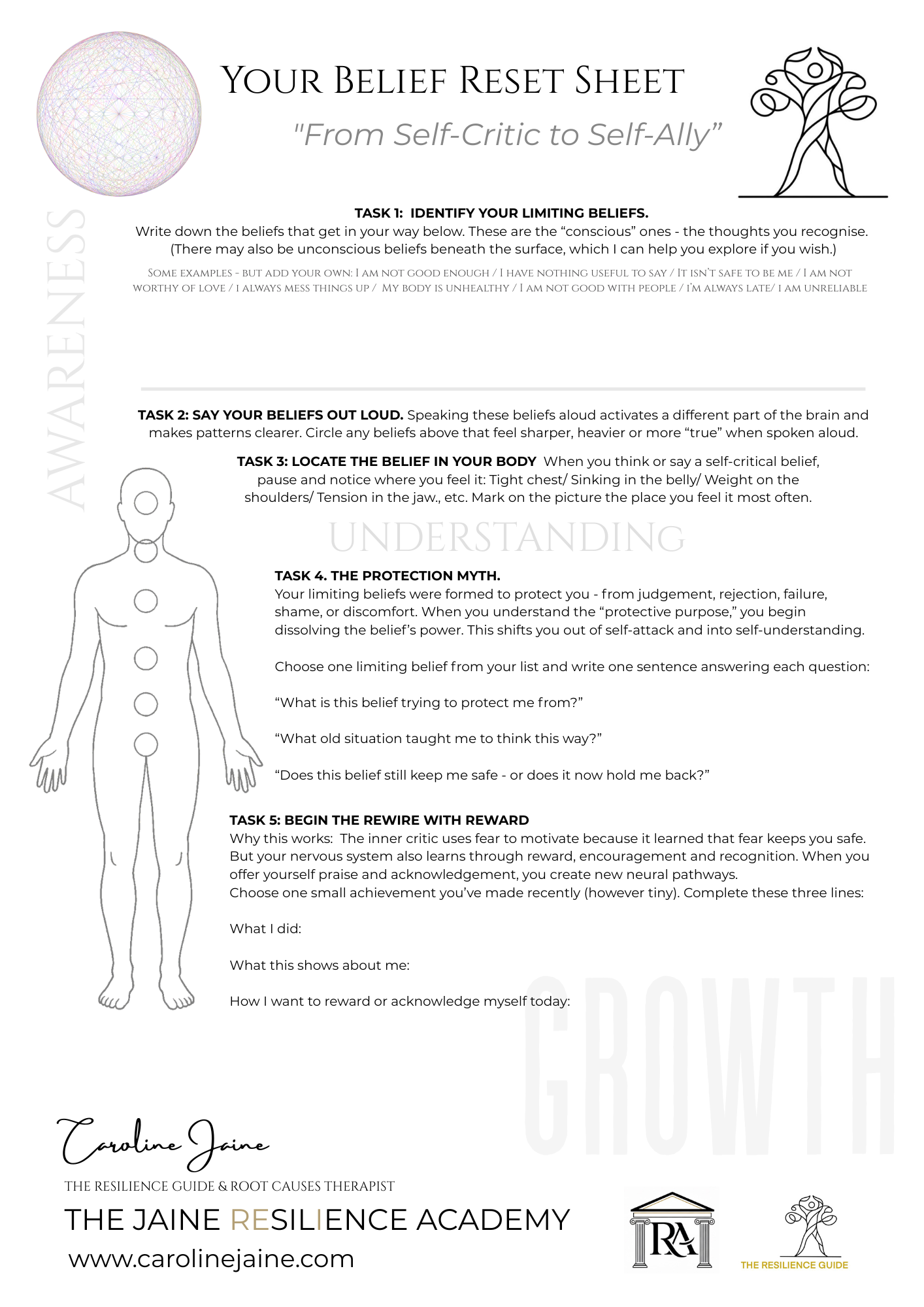
    Download the Belief Reset Sheet that goes with this Masterclass!

    This is the best present you can give yourself! This short talk explores the subtle – and often invisible – ways we respond to our own mistakes, stress, and pressure. Even high-performing people seem to push themselves through criticism, guilt, or self-punishment without realising the toll it takes on their resilience. In this session, we look at the neuroscience of motivation, why reward-based approaches strengthen the nervous system, and how people can shift from self-pressure to self-support. You’ll learn simple, practical ways to recognise your inner patterns, choose healthier responses, and build a kinder, more sustainable relationship with yourself. It’s about becoming your own ally – not your own obstacle.

    If you would like to know more about my incredible “Unbreakable Path” resilience program mentioned: This is self-directed and online using a fantastic training platform. It includes short assessments and you will be posted a printed workbook of tasks to ensure deep understanding. Plus I am always there at the end of a call if you need extra support. From 2026 I will also offer individual coaching and Root Causes Therapy. So if you think I can help you – get in touch.

    Click here for More about the Unbreakable Path

    Caroline x

    caroline@carolinejaine.com

  • I do! And people often ask why I offer free resources – Masterclasses; Reset Room Talks; guides, worksheets, and small pockets of support that I could easily package and sell. The truth: the answer isn’t complicated. It comes from my own lived experience and my deep respect for the people I serve.

    I’ve spent a lifetime working alongside strong, capable individuals in some of the most demanding environments imaginable – in policing, diplomacy, conflict zones, and even senior leaders and business owners. These are people who keep going long after others have stopped. People who are relied on endlessly. People who rarely ask for help, even when they need it most.

    And I know what it feels like to be one of them, holding everything together, carrying more than you admit; and quietly running on empty whilst telling everyone you are “fine”.

    My work – in resilience, leadership, communication and emotional regulation – is designed for exactly those people. And that’s why I offer so much for free. Not because I undervalue what I do, but because I understand the cost of waiting until it’s too late.

    Free matters when people are overwhelmed

    When you’re exhausted or stretched thin, you don’t always have the energy or the budget to commit to something big. But a five-minute message, a short talk, a simple worksheet, or a calm, grounding reminder? That can be enough to steady the day. Enough to shift perspective. Enough to help someone breathe again.

    And sometimes, that small act of support arrives at exactly the right time.

    Free is not charity. It’s accessibility.

    I share what I know because resilience is not a luxury. Clear thinking, emotional steadiness, and psychological safety shouldn’t only be accessible to people who happen to have a training budget. I have worked in environments where people give everything of themselves – and I believe they’re entitled to receive something back, without barriers.

    If I can offer free tools, or if someone else can fund the work so that people can access it at no cost, I will.

    And yes – of course I also hope you’ll invest in yourself when you’re ready

    Transparency matters to me, so I’ll say this plainly:
    I give generously because I believe in the value of my deeper work.

    My premium services – such as The Unbreakable Path: The Advanced Certificate in Resilient Leadership and individual coaching – exist for people who want to go beyond the quick steadying moment and build long-term strength, clarity and emotional resilience. My programs are grounded, research-informed, and delivered with the same attention to quality that shaped my years in diplomacy and policing. They are for those ready to commit whole heartedly to their journey.

    I offer free content so you can get a genuine sense of who I am – how I think, how I teach, how I communicate, and what working with me feels like. If my approach helps you, I hope it naturally encourages you to invest in your resilience more fully, when the time is right.

    The real reason I share freely

    At its core, my work is about supporting people who give far more than they receive. People who don’t always recognise their own limits. People who are strong on the outside and quietly overwhelmed underneath.

    I offer free resources because I believe everyone deserves a moment of steadiness – a breath, a reset, a practical insight – whether they ever work with me formally or not.

    If something I share makes just one day easier for someone who holds up the world, then it’s worth it.

    And if it also inspires you to take the next step into deeper, more personal work with me, then that’s simply the continuation of a journey that started with generosity, honesty and mutual respect.


    Subscribe to my monthly newsletters containing lots of free resources: subscribepage.io/fFcE0o

    But if you are ready to explore self development at a deeper level:

    The Unbreakable Path – The Advanced Certificate in Resilient Leadership https://theresilienceacademy.mykajabi.com/offers/pvooNwsr

  • We often talk about trusting our gut as if it’s a metaphor for instinct – but in truth, our gut has a great deal to say about who we are and how we feel. The more scientists study the gut–brain connection, the clearer it becomes that digestion isn’t just a biological process. It’s a mirror of our inner world: our history, our stress, our resilience, and even our sense of safety.

    The Science Beneath the Feeling

    The gut is sometimes called our second brain – a term that isn’t poetic exaggeration. Within the walls of our intestines lives the enteric nervous system, a network of over 100 million neurons that communicate directly with the brain via the vagus nerve. (The other two nervous systems, you will have heard me speaking about, are the parasympathetic and sympathetic nervous systems).

    This two-way communication means that what happens in your mind can affect your stomach – and what happens in your stomach can affect your mood. Anxiety might slow digestion. Chronic stress can alter gut bacteria and weaken the intestinal lining. Meanwhile, a balanced, well-fed microbiome can produce neurotransmitters like serotonin and dopamine, both essential to wellbeing and emotional stability.

    But beyond the science, there’s something deeply personal at play: every gut is as unique as a fingerprint.

    Why No Two Guts Are Alike

    From the moment we’re born, our microbiome – the community of bacteria, viruses, and fungi that live inside us – begins to develop, shaped by genetics, early feeding, environment, antibiotics, and even emotional safety. Each meal, illness, and life event continues to sculpt it.

    This means that your digestion is not simply a mechanical system, but a biography.

    What you can eat comfortably might leave someone else bloated or tired. What soothes one person might inflame another. And this isn’t just chemistry – it’s experience. If you associate certain foods with comfort or conflict, your body remembers. The gut doesn’t separate biology from emotion; it registers both.

    Tolerance Is Personal – and Emotional

    Modern nutrition advice often takes a one-size-fits-all approach: this diet heals, that diet harms. But real life is rarely that neat.

    One person thrives on sourdough bread; another reacts badly to gluten. Some feel grounded by eating meat, while others feel sluggish and uncomfortable with the idea. Some can’t tolerate caffeine because it mimics anxiety in their nervous system. Our emotional histories are intertwined with our biological ones. The foods that nourish us physically must also sit well with our psyche.

    This is why mindful eating isn’t just about manners or pace – it’s about attunement. Listening to the body without judgement and recognising that your gut might have its own opinions, shaped by years of living.

    The Non-Negotiables: What’s Bad for All of Us

    While individuality is key, there are universal truths.
    Some substances simply work against the human body – regardless of our differences.

    • Known carcinogens (like certain food additives, burnt or smoked meats, and excess alcohol) directly damage cells and DNA.
    • Ultra-processed foods often contain emulsifiers, preservatives, and refined sugars that disrupt the microbiome and drive inflammation.
    • Environmental toxins and pesticide residues can accumulate over time, quietly altering how our bodies process nutrients and regulate energy.

    These aren’t moral failings or indulgences to feel guilty about – they’re environmental realities. The more we can limit them, the easier it becomes for our gut to return to its natural intelligence.

    Learning to Listen

    Tuning into gut health isn’t about restriction – it’s about curiosity.
    Ask your body what it’s trying to say. Notice how you feel after eating, not just during. Keep a food and mood journal for a week, and see what patterns emerge.

    You might find that what your body needs changes over time – just as you do. Seasons, stress levels, hormones, and emotional load all shape digestion. Gentleness and flexibility matter more than perfection.

    A Personal System of Nourishment

    Your gut is a storyteller. It remembers, reacts, and adapts. The more compassion you bring to that conversation, the stronger and more balanced your digestion – and your mood – will become.

    There is no universal diet for wellbeing. There is only your body’s truth, waiting to be heard.
    Trust your gut – it’s not just advice, it’s biology.


    Caroline Jaine is a Resilience Guide and Creator of The Unbreakable Path

    Click here to book a free 30 minute consultation to discuss how her programs can help you or your team.

  • Understanding Psychosomatic Illness

    In the mid 19th century, Gloucester physician Ralph Fletcher was among the first to write about what we now call psychosomatic illness – the way our minds can generate or amplify real physical symptoms. His work challenged the idea that illness was purely mechanical. Instead, he proposed something radical for the time: that our thoughts, emotions, and beliefs can directly influence the body’s functioning.

    Today, that idea no longer seems radical – it’s part of how we understand the deep and constant conversation between body and mind.


    The Body’s Language of Distress

    Psychosomatic symptoms aren’t imaginary. They’re real, measurable experiences – pain, fatigue, nausea, skin reactions, or shortness of breath – with emotional roots rather than purely biological ones.

    When stress, fear, or unresolved trauma become overwhelming, the body often steps in to speak what the mind can’t. A tight chest might signal suppressed anxiety. Recurrent stomach issues can echo chronic worry. Headaches may mirror mental overload.

    It’s the body’s way of saying, “Something needs attention.”


    The Placebo Effect: Belief as Medicine

    The placebo effect offers a fascinating window into this mind-body connection. When someone experiences real healing from a sugar pill or fake treatment, it’s not deception at work – it’s belief. There is even evidence of resolution of pain when someone is told they are receiving a placebo.

    Believing that we’re receiving care triggers physiological changes:

    • The brain releases endorphins and dopamine, easing pain and elevating mood.
    • Stress hormones like cortisol drop.
    • The body’s immune response can even improve.

    The placebo effect isn’t “all in your head” — it’s a demonstration that the mind can mobilise the body’s healing systems through expectation and trust.

    In this light, psychosomatic illness and placebo are two sides of the same coin: both show how profoundly the mind can affect the body’s chemistry.


    The Role of Suggestibility

    Suggestibility – how open we are to influence – plays an important role here. It’s not a weakness, but a measure of how receptive our nervous system is to cues from others or from ourselves.

    When a trusted doctor says, “This will help,” or when we tell ourselves, “I can get through this,” our subconscious mind often responds by aligning bodily reactions with that belief. In the book “Verbal Medicine – The Language of Healing” Marc Sacco and Roger Woods share evidence that the words chosen to be said by attending paramedics can have an impact on the patient’s speed of healing. The same process can work in reverse: repeated suggestions of danger, failure, or illness can amplify discomfort or fatigue.

    In trauma recovery, mindfulness, and even leadership coaching, this principle is powerful. The language we use – internally and externally – shapes not only our mental state but also our physical wellbeing. Words can calm a racing heart or trigger tension in the shoulders. The mind listens, and the body obeys. Read more about this in my blog article Words that Heal, Words that Hurt.


    From Awareness to Integration

    Understanding psychosomatic illness isn’t about dismissing symptoms – it’s about listening differently.
    Rather than asking, “What’s wrong with me?”, we might ask, “What is my body trying to tell me?”

    This approach doesn’t replace medical care, but it enriches it. As psychiatrist Bessel van der Kolk wrote in The Body Keeps the Score, “The body remembers what the mind forgets.” Healing often begins not by silencing the symptoms, but by honouring its message.

    Psychosomatic illness reminds us that we are not machines – we are intricate ecosystems where thoughts, feelings, and biology constantly interact. The placebo effect proves that belief itself can be medicine, and suggestibility shows how powerfully words and expectations can shape our health.

    Perhaps the true lesson is not that the mind can “cause” illness, but that it can also co-create healing. When we learn to listen to our bodies with curiosity rather than fear, we open the door to resilience – from the inside out.


    Caroline Jaine is a Resilience Guide and Creator of The Unbreakable Path

    Click here to book a free 30 minute consultation to discuss how her programs can help you or your team.

  • Understanding Root Cause Therapy: Healing from the Inside Out

    “There comes a point where we need to stop just pulling people out of the river. We need to go upstream and find out why they’re falling in” – Archbishop Desmond Tutu


    Who it helps

    ☀️ People who feel stuck in a behavioural loop ☀️ addictive behaviours ☀️ types of trauma ☀️ recurring fear/phobia ☀️ unexplained anxiety ☀️ depression ☀️ chronic pain ☀️ lack of confidence ☀️ low self-esteem ☀️ Habits of overworking ☀️ feeling they need to constantly achieve ☀️unable to say no to things ☀️ repeated negative patterns in relationships ☀️ low self belief ☀️ sleep problems ☀️ low energy ☀️recurring illness ☀️ people who feel like they are losing “who they are” or their purpose ☀️ burnout


    In the world of wellbeing and resilience, we often talk about “managing” anxiety, stress, or fear — as though these feelings are wild creatures to be tamed. But what if, instead of managing our emotions, we could understand them? What if we could uncover where they truly come from, and gently release their hold?

    That’s the essence of Root Cause Therapy – a powerful, compassionate approach to healing that works not just with the mind, but with the body and nervous system too.

    What is Root Cause Therapy?

    Root Cause Therapy (often abbreviated to RCT) is a form of trauma-informed work that helps people identify and heal the underlying causes of their emotional and behavioural patterns. Rather than focusing only on symptoms – such as anxiety, avoidance, or overthinking – it looks deeper, tracing those responses back to the original experiences that shaped them.

    The premise is simple but profound: many of our current struggles are echoes of the past. The nervous system learned, at some point, that certain feelings, places, or people weren’t safe – and it still reacts as though those dangers are present today.

    Through gentle guided evidence-based processes, Root Cause Therapy helps you connect with your unconscious mind, identifies those early imprints and safely release the stored emotional charge from your body. It’s not about reliving trauma, but about meeting it with compassion, awareness, and understanding.

    “The Body Keeps the Score”

    Neuroscientist and psychiatrist Dr. Bessel van der Kolk, in his groundbreaking book The Body Keeps the Score, showed that our bodies remember what our minds may have tried to forget. Traumatic or overwhelming experiences can leave physical imprints – in our muscles, our breathing, even our posture – influencing how we feel and react long after the event has passed.

    When something in the present triggers that stored memory, our nervous system responds as though the danger is happening now. That’s why a seemingly small stressor can cause such a strong emotional or physical reaction.

    Root Cause Therapy aligns beautifully with this understanding. By helping the body and subconscious mind safely revisit and process those stored memories, it allows the nervous system to reset – bringing relief that talk-based approaches alone sometimes can’t reach.

    Why identifying the cause matters

    Imagine feeling anxious before a presentation. On the surface, it seems simple: you’re nervous about public speaking. But Root Cause Therapy might reveal that the root of that fear began in childhood – perhaps your were distressed when being criticised for “showing off” or made to feel small when you spoke up. It might be a time that your conscious mind had forgotten about.

    Once that deeper memory is brought into conscious awareness, the adult self can reframe it: “I’m safe to speak now. My voice has value.” That moment of understanding can transform anxiety into empowerment.

    The same applies to other emotions – fear, guilt, shame, even perfectionism. They all have roots somewhere, often buried under years of “coping.” Identifying them is the first step in loosening their grip. As Carl Jung said, “Until you make the unconscious conscious, it will direct your life and you will call it fate.”

    The first step: Awareness with compassion

    The journey always begins with awareness. Noticing what triggers you – what makes you tense, anxious, or withdrawn – offers clues to where healing is needed. Instead of judging those reactions, Root Cause Therapy invites curiosity: “What is this feeling trying to show me?”

    This approach sits at the heart of self-compassion. When you can witness your reactions with understanding rather than criticism, you create space for real healing. You no longer fight your emotions – you listen to them.

    Healing isn’t about fixing yourself

    Perhaps the most beautiful truth of Root Cause Therapy is that it’s not about “fixing” who you are. It’s about freeing yourself from the old imprints that have kept you in survival mode for too long. The body, once it feels safe, knows how to return to balance.

    As van der Kolk writes, “Trauma is not just an event that took place sometime in the past; it is also the imprint left by that experience on mind, brain, and body.” When we address that imprint with care and understanding, resilience naturally follows.

    Root Cause Therapy helps you:

    • Identify where anxiety, fear, or stress truly come from
    • Release the stored emotional energy connected to past events
    • Reconnect mind and body through awareness and compassion
    • Build lasting resilience from the inside out

    Healing begins when we stop asking “What’s wrong with me?” and start asking “What happened to me – and how can I bring kindness to it?”

    If you keep pulling yourself out of the river, it’s time to go upstream and find out why you keep falling in.


    BOOK A FREE CONVERSATION BEFORE YOUR THERAPY

    This is a light conversation to check whether this type of therapy is suitable for you. Root Cause Therapy is a deep, transformational practice, but it is not for everyone. An initial Zoom consultation will understand your level of commitment; whether you are undergoing any other therapies; and provide you with a deeper understanding of what is involved and how many sessions you are likely to need. This chat is free and includes a basic assessment lasting approximately 20 minutes. https://calendly.com/caroline-jaine/introductory-call or email team@carolinejaine.com

    To learn more about the many types of trauma, watch “Triggered” my Masterclass on trauma below.

    Caroline Jaine